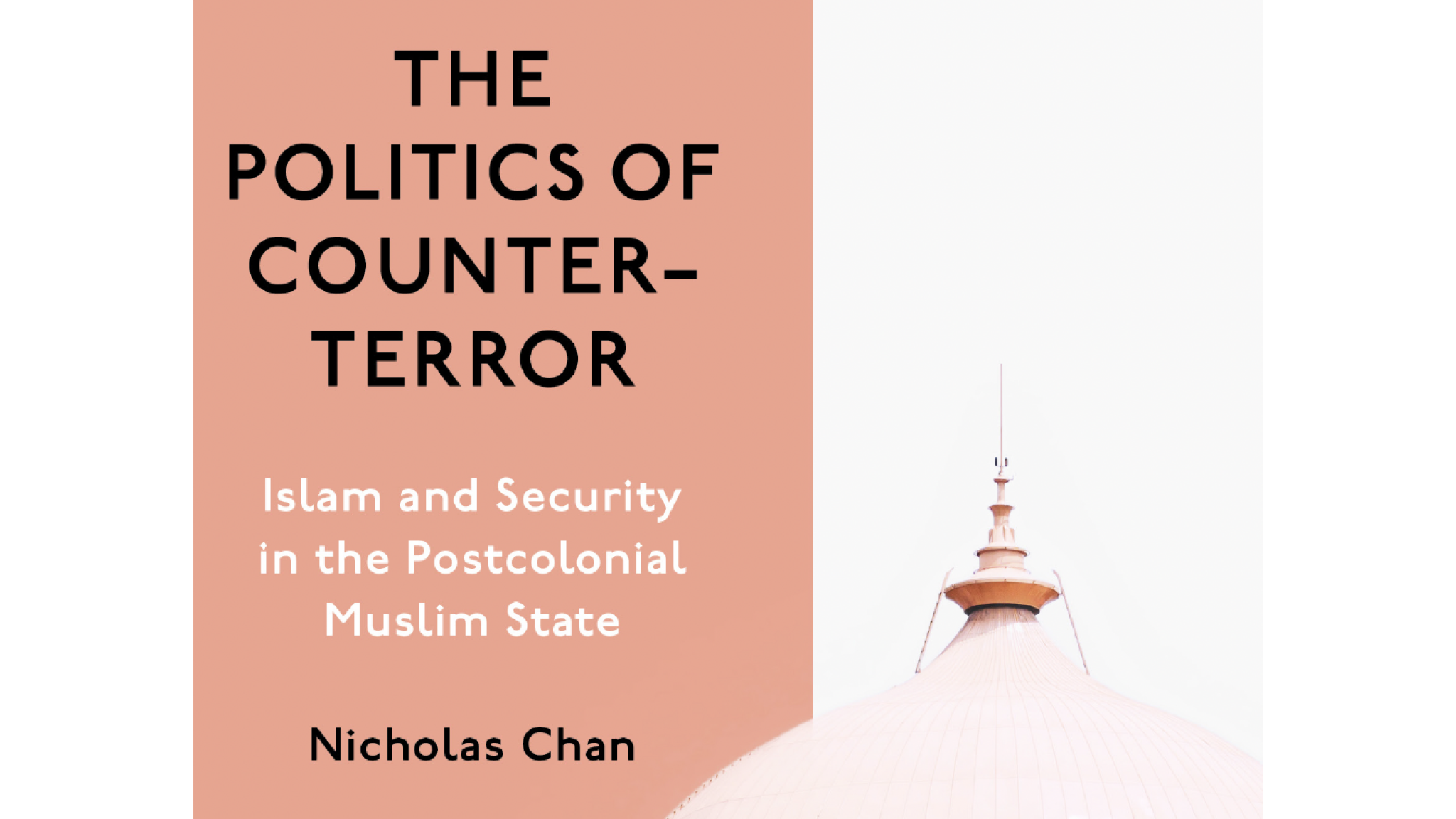
Book Launch: The Politics of Counter-Terror in Malaysia

On 13 August 2026, the ANU Malaysia Institute and Strategic and Defence Studies Centre of the Coral Bell School hosted the launch of Nicholas Chan’s new book, The Politics of Counter-Terror: Islam and Security in the Postcolonial Muslim State. Published by Stanford University Press, the book examines how Islam and counter-terrorism are intertwined in Malaysia because of status concerns and a security logic that often conflates the governance of Muslims with the governance of Islam. Associate Professor Amy King chaired the launch, with Dr Sarah Logan and Emeritus Professor Greg Fealy as discussants. Dr Ying Xin Show delivered the welcome remarks as Director of the ANU Malaysia Institute.
At the launch, Dr Chan posed a question at the heart of the book: what does it mean for a Muslim-majority state to prosecute a global ‘war on terror’ that also stigmatises their religion? He argued that the Malaysian case provides an account of securitisation that is very different from more instrumentalist takes that merely treat religion as being appropriated for political control or repression. The Malaysian case also differs substantively from other Muslim states because close religion-state ties did not stymie effective counter-terrorism.
Instead, Malaysia experienced a twin process: the securitisation of Islam and the Islamisation of security. These processes occurred alongside state-building efforts by national elites who sought to demonstrate that Islam was compatible with industrial modernity. The securitisation of Islam happened as Muslim elites and bureaucrats increasingly saw regulating the parameters of Islam as a national security imperative. The Islamisation of security, in turn, refers to institutional arrangements under which Islamic actors, institutions, and reasoning are increasingly wedded to daily security practices.
As a result, counter-terrorism in Malaysia ended up operating as an enterprise that assumes radicalism as primarily a religious problem. The book makes a unique contribution to Malaysian studies, Asian security, and the international relations literature by connecting original empirical work that traces counter-terrorism across different domains of governance (policing, religion, and law, etc.) with a sophisticated theorisation of how religion matters within a postcolonial politics of recognition-seeking.
Reflecting on why this perspective on the War on Terror in Southeast Asia matters now, Dr Chan suggested that Malaysia’s experience offers a way to understand how states outside the West participated in global governance projects they may have conflicted feelings about. It also shows how this search for recognition in the international order can shape the daily realities of governance at work.
For more on the book, please visit this blog article.